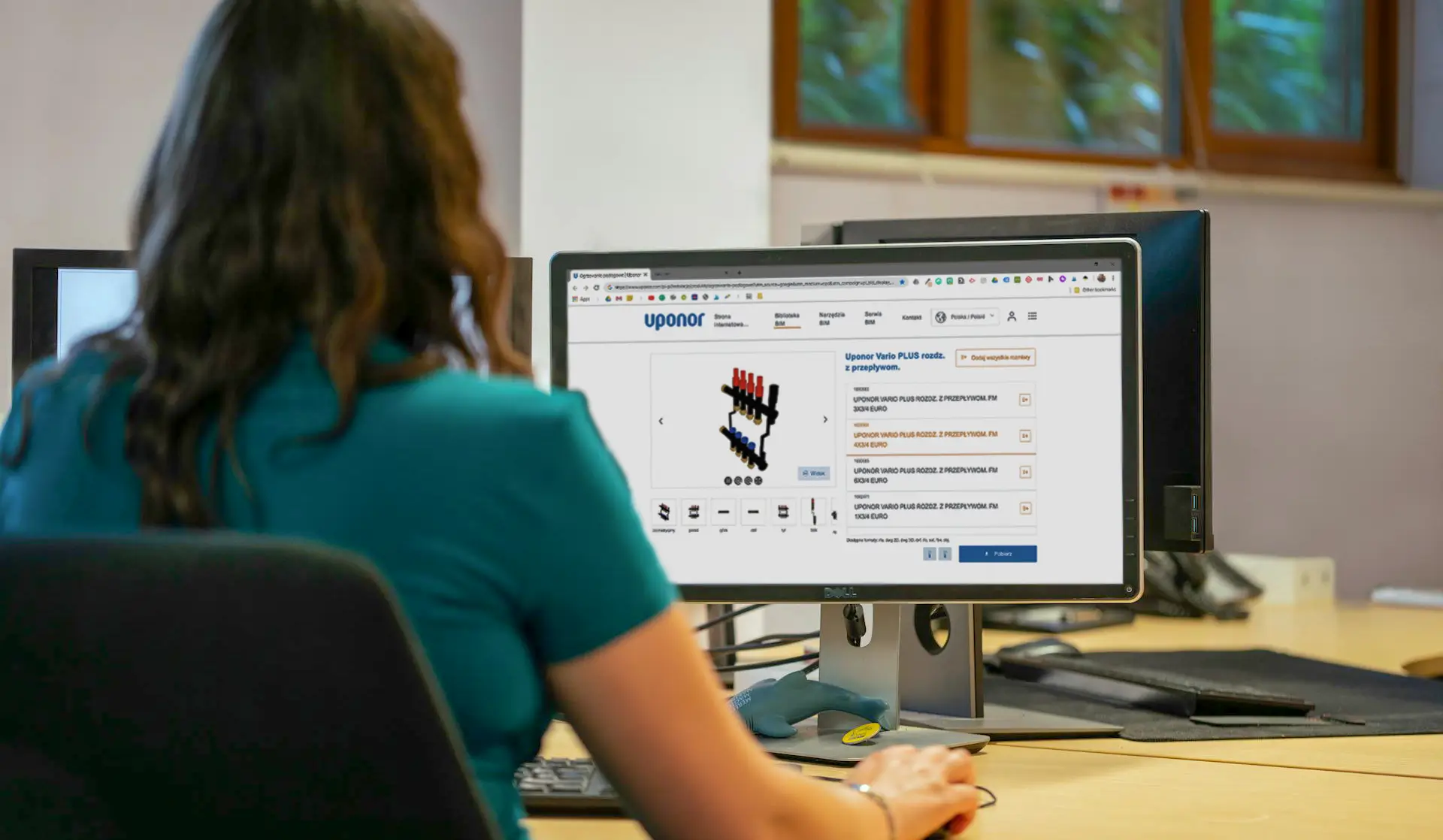
In this article, you will learn what BIM content is, why construction manufacturers should care about it, and how to properly prepare and manage BIM data.
Article contains
What exactly is BIM content?
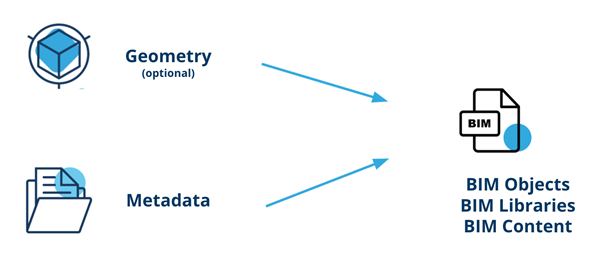
BIM content (Building Information Modeling) is also referred to as BIM libraries or BIM objects. These terms are interchangeable and always refer to a digital representation of a product – such as a window, door, pipe, or furnace – that can be used as part of a BIM model or project.
BIM content consists of:
Geometry – a three-dimensional, graphical representation of the actual product, including dimensions, connection points, etc.
Metadata – attributes representing both geometric features (e.g., width, height) and non-geometric features (e.g., name, description, EAN code, ETIM class, etc.) of a given object.
While it might seem that the visual appearance of a product's shape is the most important part of BIM, the reality is quite the opposite. A BIM object can exist without geometry and have a flat structure (e.g., paint, structural layers, materials), but it could not exist without metadata. The "I" (for Information) in the BIM acronym is what matters most.
Information contained in product libraries is used at every stage of a construction project – from the concept phase and design to the management of the completed building. By gathering such information about a building in one place, BIM technology enables:
more effective decision-making and obtaining necessary project permits,
error reduction through the anticipation of construction issues or collision detection,
the implementation of mechanisms focused on the health and safety of people inside the building,
consistency in project documentation and a high level of productivity,
the ability to monitor the facility's condition in detail and with flexibility, allowing for the arrangement of ongoing maintenance or changes to building assets (renovations, upgrades),
cost efficiency – enabling the estimation of costs and the future profitability of the facility,
BIM is also considered an excellent step toward fostering collaboration among all participants in the investment process and ensuring transparent communication. In the next paragraph, you will learn why manufacturers in the construction sector invest so heavily in BIM technology.
Why should manufacturers consider investing in BIM technology?
BIM is, first and foremost, an investment in sales. By providing high-quality object libraries, a construction manufacturer makes it easier for architects and engineers to use their products during the design phase. As a result, a specific product can be included in a project long before the investor makes a purchasing decision.
This is because designers today work primarily on digital 3D models created in tools like Revit or Archicad. However, the generic design components available in these programs are often insufficient for preparing detailed projects. Objects containing real product parameters – such as dimensions, technical properties, and other information relevant to the project – are required. This is the role played by product libraries prepared by manufacturers.
By providing their own BIM objects, a manufacturer gives design teams a ready-made tool to incorporate their products into their projects. This is important because a product included in the design documentation has a better chance of remaining in the specification throughout the subsequent stages of the investment. Instead of reaching the customer only at the point of purchase, the manufacturer can appear much earlier – at the moment when designers are making decisions that influence the selection of specific solutions.
That is why implementing BIM should not be viewed by manufacturers solely as a technology investment. It is also a way to increase brand visibility in the industry, support architects in their work, and get your product into projects at the specification stage. Well-prepared BIM content can effectively drive sales and increase the likelihood that the product specified in the design will ultimately be chosen by the investor. We wrote more about this in our article: "How is BIM technology changing sales strategy in the construction industry?"
Are you a manufacturer looking to start sharing your own BIM libraries? Get in touch with us to schedule a free analysis of your company's BIM potential!
Well-prepared product libraries should reflect not only the specifics of a given product but also the requirements of the market where they will be used. An architect in Germany may need different information than one in the Netherlands or Poland, due to language, local regulations, and the classification systems in use.
Therefore, when preparing content, it is worth considering:
required approvals, certificates, standards, and technical information for a given market,
local and international classification systems, such as ETIM, OmniClass, or Uniclass,
appropriate language versions of product data,
ensuring regular updates of parameters and current product information.
With a large number of products, languages, and markets, manually preparing and updating all variants quickly becomes difficult to scale. This is why manufacturers are increasingly using systems that allow for the coordination of an entire product library from a single location.
BIM management solutions
One such tool is BIMStreamer, a platform that enables manufacturers to centrally manage their digital product libraries and their distribution.
The system allows for, among other things, automating the generation of files for different countries and languages based on a single data source. As a result, the manufacturer does not need to maintain separate libraries for each market, and changes to product information can be automatically reflected in published files, ensuring better control and consistent data.
BIMStreamer also enables:
adapting product data to the requirements of specific markets,
creating anonymized versions of files for public tenders,
publishing libraries across multiple channels, such as the manufacturer's website, design software plugins, or applications,
analyzing downloads and how designers use the products.
As a result, the library ceases to be just a collection of files for download. It can become a managed digital distribution channel for product information that simultaneously supports designers and provides the manufacturer with data useful for sales and product development.
Case study: BIM platform and Autodesk Revit plugin for Uponor
A good example of using BIMStreamer is Uponor, a global manufacturer of installation solutions operating in over 30 markets. The manufacturer's challenge was managing a large product library that varied by country, language, and local offering.
Thanks to the integration of BIMStreamer with their PIM system, the manufacturer can now automatically generate and update the appropriate file versions for individual markets. A dedicated BIM tool we created for Revit further supports designers in tasks such as component selection and preparing bills of materials.
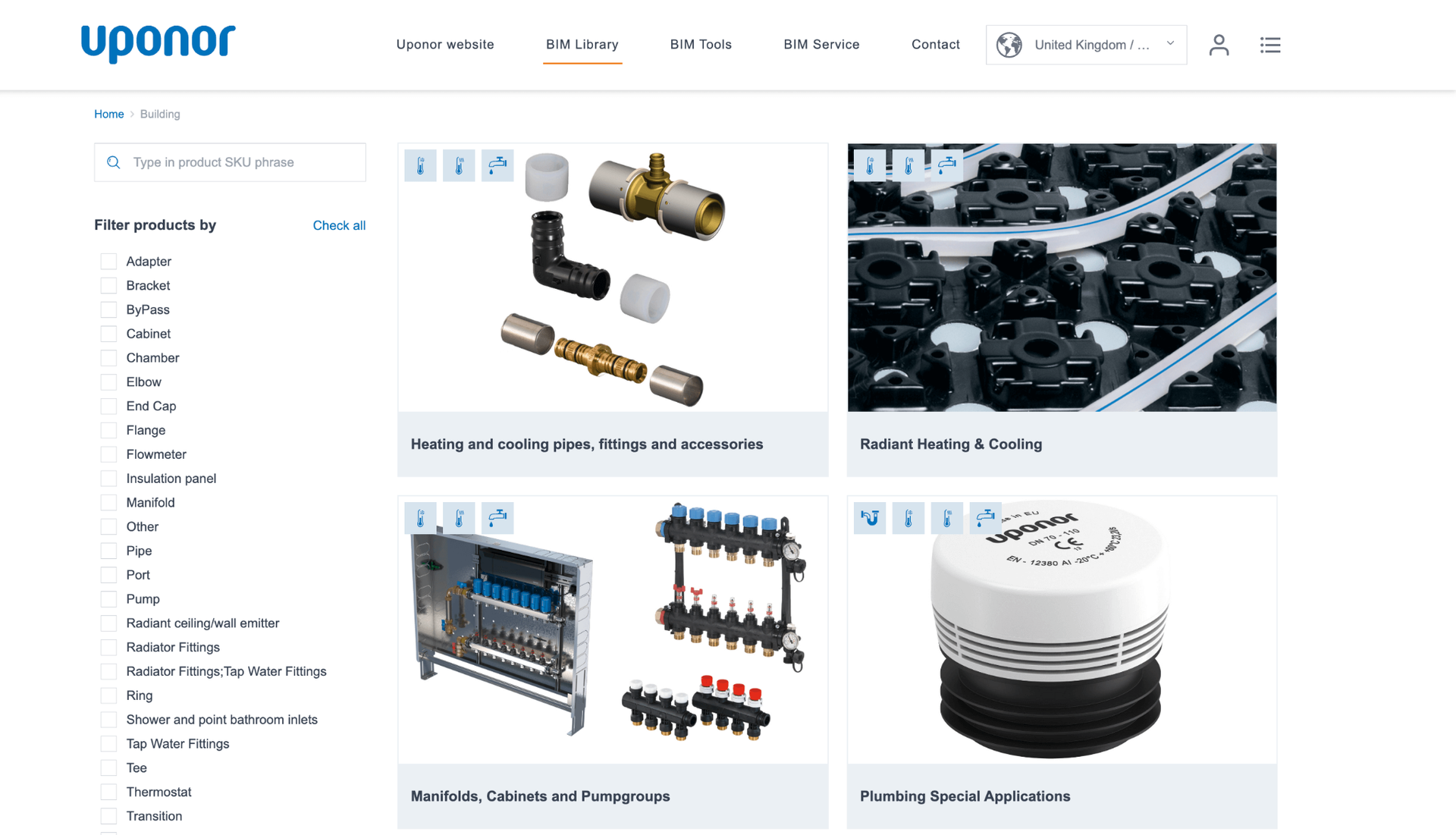
Uponor's BIM platform powered by BIMStreamer functionality
The solution currently supports approximately 4,000 SKUs, over 30 countries, and 20 languages, with the Uponor platform automatically generating more than 120,000 BIM/CAD files.
BIM implementation for manufacturers
If you are a manufacturer looking to implement BIM, it is worth defining the scope, priorities, and implementation schedule from the very beginning. It is particularly important to organize product data, prepare the necessary language and market versions, and establish a process for future content updates.
Well-prepared content makes it easier for engineers to include specific products in construction projects, which in turn increases the chances of them being used during the actual build. As a result, BIM can effectively support sales and help manufacturers get their offerings into the design process earlier.
Subscribe and receive additional content, checklists and business automation tips from us.
Thank you for subscribing to our newsletter!
You will soon receive a welcome message at the email address you provided.
Ups! Coś poszło nie tak, nie udało się wysłać formularza.
Build your BIM strategy with us!
As BIMStreamer, we help construction manufacturers model Revit families and plan their distribution strategies. Contact us to see how you can take your sales to the next level with BIMStreamer solutions.
PIM to BIM — how to integrate product data and improve information management?
Are you a construction manufacturer looking for a way to integrate product data from the PIM system into your BIM files? Read our article and learn how to efficiently implement PIM to BIM.
Read
PIM systems
bim-libraries-updating
Why is not updating BIM libraries a threat?
BIM catalogs of your products are downloaded once, and then they probably live a life of their own in hundreds of projects. If in the meantime you change the parameters of your products, and the information about this does not reach the engineers, the risk is transferred directly to the construction site. In this article, we show you why a passive approach to BIM updates can be costly — and how to effectively prevent it.
Read
Sales
bim-in-public-contracts
BIM in public procurement and tenders — how to prepare libraries?
For the manufacturer of the construction sector, public investment is a gold mine. However, the road to them is riddled with legal pitfalls. Read the article and find out what to do for your products to be chosen.
Read
Do you want to implement your own BIM platform? Write to us!
Book a free consultation with our specialist and find out how BIMstreamer can help you promote your products.
Thank you for contacting us!
Your message has been successfully sent. We will reply as soon as possible.
Oops! Something went wrong, failed to send the form.



.webp)
.webp)