Read the article to learn how to approach a BIM implementation project for manufacturers so that your products successfully reach construction projects.
Article contains
Why do companies decide to start BIM at all?
For a manufacturer, BIM implementation should not be just a technology project – it is primarily an investment in product sales and marketing.
An increasing number of medium and large construction manufacturers are already making their products available as BIM objects. Designers can download a ready-made file, place it in their project, and work directly with the actual parameters of a specific product. If you, as a manufacturer, are not yet providing such materials, your products may be less attractive to architects. Even if they know your brand and want to use a specific product, if they don't receive the appropriate materials, it is often easier for them to choose a competitor's solution that is already available for use in their design environment.
This is precisely why well-prepared BIM libraries can effectively support sales. They help companies reach designers with their products at a very early stage of an investment and increase the chances that a specific solution will be included in the project.
Where should manufacturers start when it comes to BIM implementation?
BIM implementation is a process that requires time, employee commitment, and an appropriate budget. Therefore, before you start ordering models, buying software, or building your own online library, it is worth planning the entire process carefully.
Below you will find a short guide for construction manufacturers who want to start providing BIM to designers and use this technology as part of their sales strategy.
Appointing a person responsible for the BIM implementation process
The first step should be to appoint a person who will be responsible for the entire implementation process. This does not mean that one person must independently create models, manage product information, select technologies, and handle distribution. However, they should coordinate all these activities and serve as a point of contact between individual company departments and external technology providers.
In larger organizations, this role is usually filled by a BIM Manager, Digitalization Manager, or a person responsible for product digitalization. If your company does not yet have such a position, it is worth considering creating one or at least clearly assigning responsibility for BIM to a specific person. This is particularly important because BIM implementation usually connects several areas of the company: product, IT, marketing, sales, export, and product information. Without a process owner, it is easy to end up in a situation where libraries are created by different departments and different providers, but no one is responsible for their accuracy and further development.
Market analysis and budgeting
The next step is to check the potential of BIM for your company. To do this, it is worth answering a few basic questions:
What kind of projects are our products used in?
How many architects potentially interested in our products work in BIM?
In which markets is this technology already a standard?
Do we want to prepare libraries only for the local market, or are we thinking about international expansion from the start?
The last question is of great importance. A library prepared in only one language and according to the requirements of one market may require additional work in the future if the company decides to expand. It is therefore worth considering in advance whether multilingual support and the ability to create different library variants for individual countries will be needed.
At this stage, it is also worth contacting technology providers and companies that create BIM models. This will allow you to learn about available options, compare cooperation models, and prepare an initial cost estimate. The budget should be analyzed in the context of potential business benefits. The goal is not to prepare as many libraries as possible, but to ensure that the investment in BIM is proportional to the sales potential of the products and the markets in which the company operates.
Product information audit
As we wrote in the article Does BIM for manufacturers require a PIM system? Companies planning to implement BIM often fall into the trap of seeking perfect product information. Manufacturers assume they must first implement an extensive PIM system and organize all data within the organization before they can start working on BIM. In practice, this approach can delay a project by many months or even years.
You don't need a complete enterprise-class system to get started. First and foremost, you need a basic set of organized information that will allow a designer to use the product correctly. This usually includes:
product name and code,
basic dimensions,
key technical parameters,
information required for the proper application of the product.
This data is very often already available within the company—for example, in Excel spreadsheets. And that may be enough to start the project. From an architect's point of view, it is less important whether the data comes from an advanced PIM system, an ERP, or a properly prepared spreadsheet. The most important thing is the result: the BIM object should contain correct information and function properly in the project.
Therefore, before you start creating libraries, it is worth conducting a product data audit. You need to check what information you already have, where it is stored, whether it is up to date, and what might be missing. This makes it much easier to define the scope of the project and avoid problems at later stages.
Selecting the products and BIM file types to start with
You don't have to prepare libraries for your entire catalog right away. First, check which projects your products are used in and how often BIM is utilized in them. If you offer several product groups, start with those that have the greatest potential for use by designers.
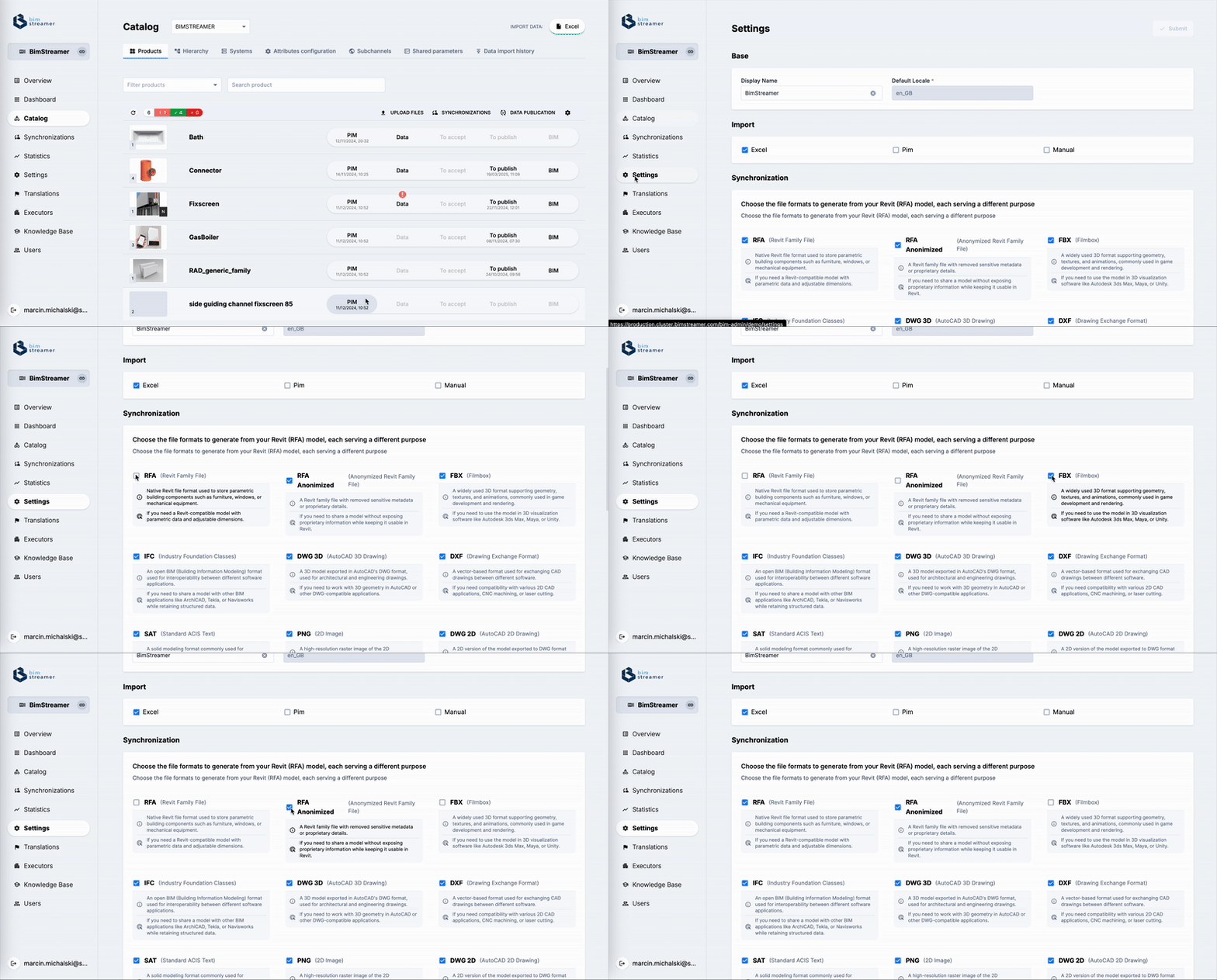
At this stage, it is also worth determining the necessary file formats. These can be BIM files such as RFA, RVT, or IFC, but CAD formats, including DWG, DXF, and SAT, are also popular.
Creating libraries – what possibilities do you have?
Once you know which 3D models you want to prepare and have your data organized, you canget started with BIM. When modeling libraries, manufacturers most often choose one of two paths:
Outsourcing library creation – models are prepared by external companies. This is a simple way to get started, but the process remains partially outside the manufacturer's control. Problems arise especially when libraries for different markets are created by several suppliers, which can lead to chaos in versions, data structure, and updates.
Automatic library generation – solutions like BIMStreamer allow you to create BIM files based on base models and data from Excel or a PIM system. This makes it possible to generate subsequent product variants faster, reduce manual work, and lower the costs of maintaining libraries.
Automating BIM generation in BIMStreamer
Automation is particularly important for manufacturers with a large number of similar products that differ in dimensions or technical parameters.
We discuss more about different ways to create libraries in our YouTube video:
When choosing how to create libraries, it is worth considering not only the cost of their preparation but also how easy they will be to update and expand later.
Choosing a solution for BIM library distribution
Preparing BIM files is not enough – you also need to ensure that designers can easily find them.
Theoretically, a manufacturer has three options:
sending libraries via email to those who request them,
publishing them on external BIM marketplace portals,
creating your own BIM library platform.
We do not recommend the first solution as a primary distribution channel. If a company has already invested in creating libraries, passively waiting for inquiries severely limits their potential. It is much better to actively make products available where architects are actually looking for them.
Hosting libraries on external BIM marketplace portals
A BIM marketplace provides access to an existing audience and can be a good solution for smaller manufacturers. The company publishes libraries on an existing site and does not have to build traffic on its own.
The downside, however, is less control over how products are presented and the relationship with the user. The user interacts with the intermediary's platform, and the manufacturer does not always have full access to data on those downloading the BIM files.
Creating your own BIM platform for architects and engineers
Your own platform gives the manufacturer greater control over the entire process. The company decides how products are presented, what data the user sees, and how the library integrates with other marketing activities.
An additional advantage is the ability to generate your own leads and build a direct relationship with users. The downside is the need to drive traffic to the platform yourself.
The best solution? Combining both channels
In many cases, a hybrid strategy works best. You can list your most popular products on marketplaces to leverage their reach, while keeping your full library on your own website.
In the libraries shared on external platforms, you can also include links to full documentation, the latest product versions, or your entire manufacturer library. This turns the marketplace into a channel for acquiring new users, while your own platform remains the primary hub for building relationships with designers. We discuss this BIM distribution strategy in more detail in our article: https://www.bimstreamer.com/en/blog/bim-marketplace-or-your-own-bim-platform
We help building product manufacturers deliver BIM objects to architects effectively – contact us to schedule a free BIMStreamer demo!
The final element to consider right at the start of implementation is long-term library management. The nature of BIM technology is such that preparing an object is not the end of the work. Products change. New variants appear, along with different technical parameters (e.g., carbon footprint, compliance with local or international standards like ETIM), documentation updates, or entirely new product lines. On top of this, there are new legal requirements, product information standards, and the need to adapt libraries for new markets and languages.
The larger the company, the more difficult it becomes to manually track all these changes.
That is why it is worth creating a BIM management strategy during the initial implementation phase. It should define, among other things, where the primary source of information is loated, who is responsible for updates, how changes are applied to objects, and how new library versions are published across various channels.
Although it may seem like a complex process at first, a well-designed system allows a significant portion of these tasks to be automated. Manufacturers such as Uponor, OBO, and Aliaxis have automated their BIM management processes using our BIMStreamer software.
BIMStreamer is a BIM Content Management solution for manufacturers. It allows you to centrally manage BIM objects, automate their updates, and publish relevant libraries across multiple distribution channels. Instead of manually correcting hundreds or thousands of files individually after every product change, you can manage the entire process from one place and update multiple files simultaneously. Additionally, BIMStreamer enables integration with marketing and sales activities, including PIM systems, e-commerce platforms, CRMs, and other sales tools. As a result, our solution not only helps organize BIM processes but also actively generates sales for our clients.
At a later stage of your BIM strategy, in addition to BIM content management software, it is also worth considering implementing a PIM system, especially for companies with extensive portfolios operating in multiple markets. Integrating PIM with a library management system can enableautomatic data exchange between different channels. A change in product information can be made in a single source and then pushed to your website, catalogs, sales systems, and BIM objects, among others. This approach is particularly important during international expansion, when a company must manage multiple language versions and varying scopes of product information.
Ready to implement BIM in your company? Ask about a pilot project with BIMStreamer
A pilot project will allow you to see how BIMStreamer can streamline the creation, updating, and distribution of BIM libraries within your company's real-world processes. Contact us to schedule a free consultation, during which we will explain how you can test BIMStreamer in your organization.
BIM automation in n8n and AI in the sales of building materials
Manufacturers of building materials often do not know how to collect and turn data about the use of their products into a competitive advantage. Read the article and learn how collecting data from Revit and automating BIM processes will help you accelerate your sales and gain a real market advantage.
Read
Marketing
data-ownership-in-bim
Why Without Full Data Ownership You Lose Control of BIM Strategy
In the era of digital transformation, data is the new currency. As a manufacturer, you invest huge resources in the digitization of products, including the creation and distribution of BIM libraries and the generation of traffic. But have you ever asked yourself a crucial question: What happens to these assets if you decide to switch technology providers tomorrow?
Read
Sales
bim-in-building-materials-sales-strategy
How is BIM changing the sales strategy in the construction industry?
Manufacturers of building materials are increasingly faced with the question: how to increase sales in a world where digitization of projects is becoming the norm? The answer is BIM libraries — a solution that combines the technical data of products with the requirements of designers and investors, while building a competitive advantage for the manufacturer.
Read
Do you want to implement your own BIM platform? Write to us!
Book a free consultation with our specialist and find out how BIMstreamer can help you promote your products.
Thank you for contacting us!
Your message has been successfully sent. We will reply as soon as possible.
Oops! Something went wrong, failed to send the form.


.webp)



.webp)
.jpg)
