Costly silence — how outdated BIM libraries led to the forging of reinforced concrete
Let's start with a real-life story, which to this day keeps a certain manufacturer of openwork carpentry awake at night. The company updated the dimensions of its fire doors in the catalog offer, slightly changing the width of the door frame. The technical change was implemented in production, but... no one thought of effectively informing the designers about the change, who downloaded BIM files and used them in the project already half a year earlier.
The effect? On a large public investment, ceilings and walls were poured with an opening prepared for the “old” dimension from the outdated BIM library. When the door arrived at the construction site, it turned out that it physically did not fit into the prepared openings.
There was no option for replacing the doors — these were certified fire-fighting products manufactured to order. The construction company ended up bringing in a specialist crew with diamond cutting equipment to widen the holes in the reinforced poured concrete. Costs? Astronomical. Delay? A few weeks. The image of the manufacturer? Devastated. The investor remembered only one thing: “These are the ones from that door through which we had to prick concrete.”
This scenario could have been avoided with one small notice.
Outdated BIM File Problem — Delayed Ignition Bomb
Such a phenomenon, which we described above, is called the problem of “Zombie Files” - outdated BIM files that “live” on hard drives of architects and servers of design offices, generating erros, over which the manufacturer theoretically has no control.
Architects work under pressure. If they have your object in the “Favorites” folder, they will use it in the next project, without checking each time on your page if something has changed. They treat BIM catalogs like a brick — once bought, it does not change its properties. But in the digital world, data is getting older. And as the story with the door shows, it is you who bear the risk — both business and image.
Passively waiting for an engineer to check an update is asking for trouble
Most BIM platforms take a passive approach: they update the libraries in the database and count on the designer to go to the site himself, notice the change and download the new version. Let's be honest — this is not happening. A designer finds out about a mistake usually when an angry construction manager calls him.
Therefore, modern library management requires a proactive approach.
BIM object distribution system that “screams” when product data changes
In most popular BIM platforms and marketplaces, updating an object ends up replacing the BIM model in the library. The manufacturer does not know who downloaded this model, where it is used or if the engineer is working on the current version, and this means that he is not able to indicate specific people who should be informed of the changes. So its only opportunity to reach users is to publish general information on the site or send a mass newsletter. The manufacturer has no certainty that among the designers to whom the news will reach will be those actually using the revised BIM library.
In such a scenario, information about the change exists only “passively” — it is available in the system, but does not actually reach the user, which in practice leads to the continued use of outdated product information in projects.
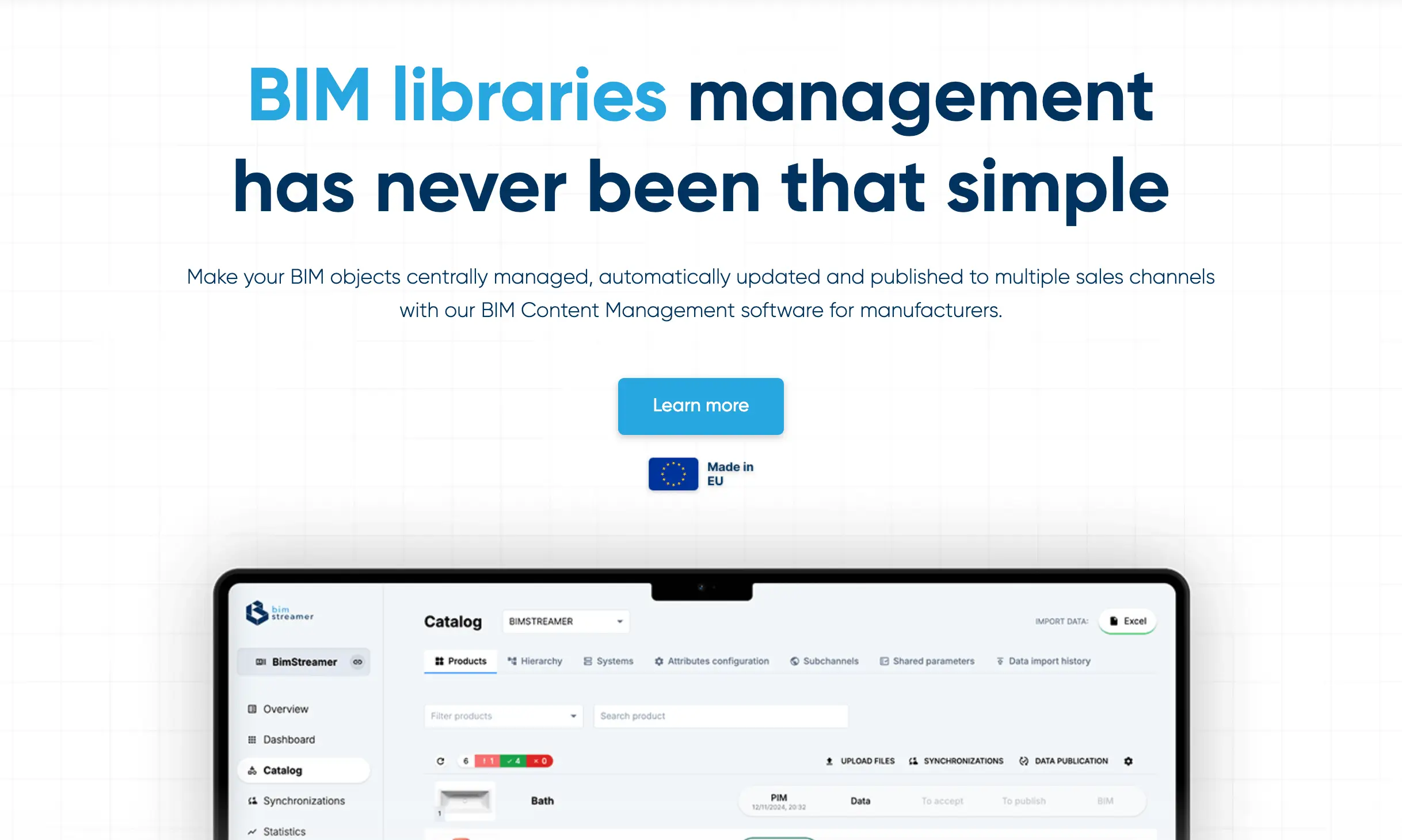
Therefore, informing civil engineers about changes in BIM data must be systemically active and forced and not left to the good will of the user. This is where systems such as BIMStreamer, which eliminate the problem of outdated BIM object libraries through an automated notification mechanism.
However, this is no ordinary newsletter. it Precise safety mechanism, which works regardless of whether the user himself “checks for changes”. The system responds to any correction of data or geometry and initiates communication itself, so that the update information actively reaching out to the right people.
How does the BIM library update notification system work in BIMStreamer?
- Full user traceability: the system remembers the history of downloads. Knows exactly which designer (specific email address) downloaded the file — regardless of whether they did it by Online Library (browser), or by dedicated BIM Plugin in Revit or Archicad software.
- Automatic change detection: when your product department updates data (e.g. dimensions, parameters in PIM) or withdraws a product, BIMStreamer recognizes the creation of a new version.
- Action (Alert): the system automatically sends an email to all users who have downloaded an older version of this particular file.
Thanks to this change notification process, the architect who downloaded your 3D model can design with peace of mind, confident that the system will automatically inform him of every change in the catalog.
Order a free demo of BIMStreamer and see how the process of automatic updating of BIM libraries in our BIM content management system for building materials manufacturers looks like.
Ask for a demoMail updater that saves the project
Such a message is not marketing spam. This is a technical advisory. The message in the email to the user is simple: “You are using the X door product library. We have made important dimensional changes to it. Your version is out of date. Download the correct file here”.
Thanks to this solution, as a construction manufacturer:
- Avoid accidents at the construction site: the designer gets a warning before sending the project to the contractor.
- You build the image of a partner: you show that you care about the quality of the client's documentation even months after downloading the file.
- You have a clear conscience: in case of problems, you have proof that you have informed users of the change in the specification.
Always up to date documentation with BIMStreamer
Implementing BIM in a company is not just about sharing files. This is the responsibility of the information flow process. Fortunately, you don't have to manually write to hundreds of architects when you change the dimensions of the door frame. BIMStreamer will do it for you, sending a notification to anyone who downloaded the file — no matter how they did it. Make sure that on construction sites with your products the only noise is the sound of assembly, not the forging of reinforced concrete.