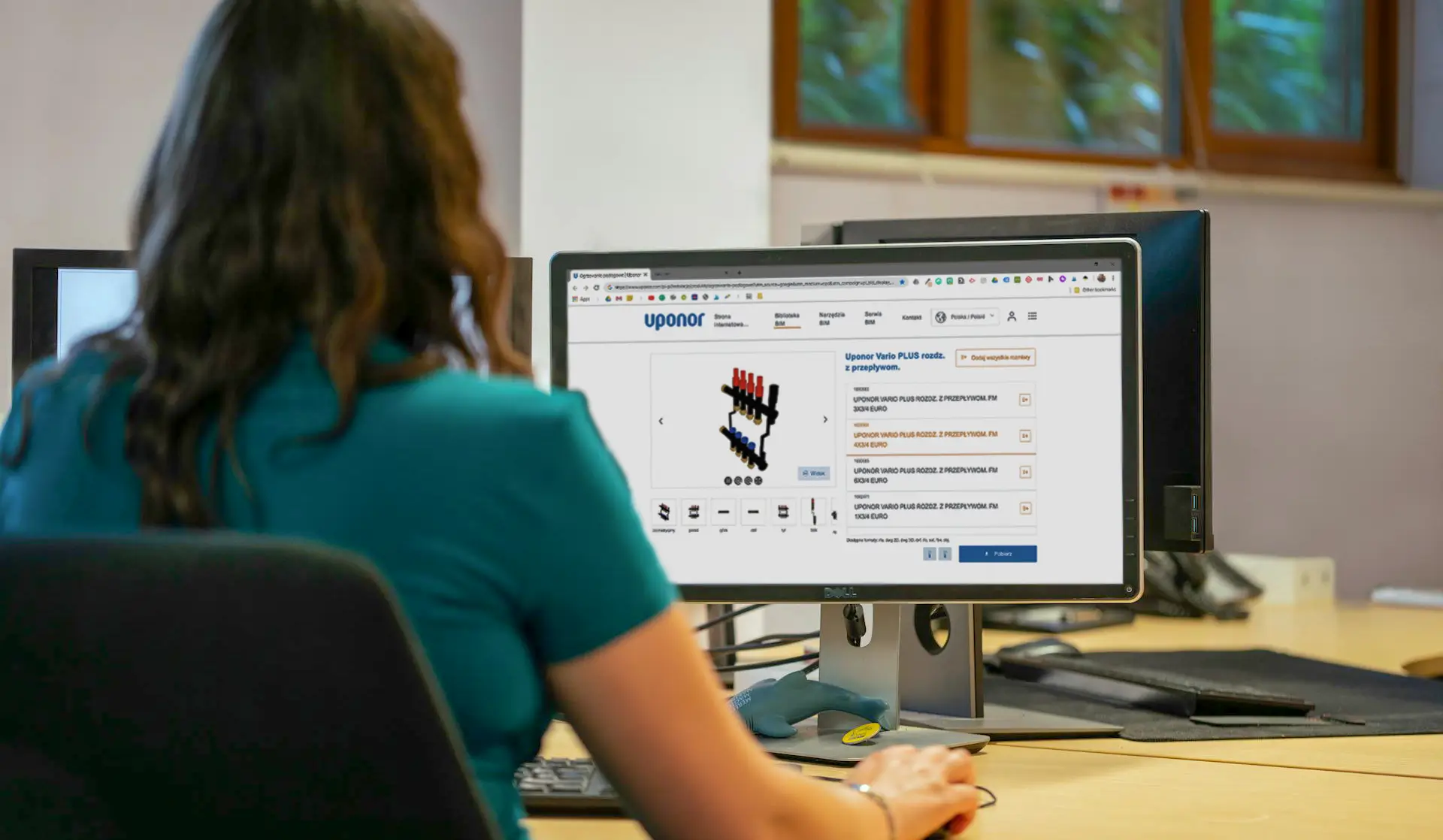
For the manufacturer of the construction sector, public investment is a gold mine. However, the road to them is riddled with legal pitfalls. Read the article and find out what to do for your products to be chosen.
Article contains
Why are most BIM libraries not adapted to public procurement?
Public tenders are governed by their own very precise rules. Any manufacturer of building materials that wants to successfully enter the public investment market must not only meet a number of formal requirements, but also be able to properly communicate them in the tender documentation. In the world of increasing digitalization of construction — and especially application of BIM (building information modeling) — this means the need for perfect preparation of digital documents that meet the standards of the subject of the contract.
The problem is that BIM technology combines technical data, performance characteristics and information about the manufacturer in a single model. In public procurement, however, it is banned to indicate specific brands. So a paradox arises: how do you provide the designer with a library of your product when you cannot include data pointing to your company in BIM models?
It is at this stage of submitting BIM models in public tenders that most manufacturers make two typical mistakes:
Manufacturers send designers models that are fully branded — so they cannot be used in the tender documentation without modification.
The second group of manufacturers creates files so general and imprecise that, as a result, the tender can be won even by the competitor with the cheapest replacement. Therefore, the proper preparation of BIM libraries becomes a key element of effective participation in public procurement.
BIM models that are not adapted to public tenders make the design process more difficult
Imagine an architect preparing a project for a school or hospital. It must operate in accordance with the Public Procurement Law. Architect downloads your BIM library, and he or she finds out that: in the family name there is also name of your company, in the parameter “Manufacturer” you've placed your company name, in the description – a link to your site and in the 3D model someone placed the logo.
What does a building designer do in such a situation?
Gets annoyed because the BIM library is an advertisement when only the technical data is needed.
Wastes time to manually delete (clean) all proper names from the BIM file.
Or... completely abandons your BIM files and inserts a generic cuboid that describes nothing in the project generalizations.
In each of these cases, you, as a manufacturer, lose the project. Your company implemented BIM methodology in its processes for winning, not losing the public tenders.
Manual cleaning of BIM models and their presence in the design
When a tired designer manually anonymizes your file, he usually removes everything that seems unnecessary to him, as long as the file is legally “clean” and thus suitable for use in a public project. Often, by accident, it also removes specific technical parameterswhich make your product stand out from the competition (e.g. specific heat transfer coefficient, unique acoustic class or specific mounting technology). What is the effect of such Anonymize BIM file quickly? Usually a specification is created so general that after evaluating the offers, the tender is won by the company with the cheapest product, and not the one that was originally used in the project. yours so the product disappears from the investment, even if your BIM file was used as the database.
Manufacturer-controlled anonymization of BIM libraries
To win in public procurement, you need to provide the designer with a BIM file that, on the one hand, is ready to use (legally compliant), and on the other hand protects your interests (that is, it is technically precise).
This is where the automation offered by systems such as BIMStreamer. Instead of relying on the designers to rework your file correctly, you can program the entire process of anonymizing BIM libraries before they are downloaded at all.
This mechanism is based on the preparation of attribute pairs. In the BIMStreamer system, you can define two values for each parameter:
Commercial value: e.g. “Manufacturer Name: Company X”, “Model: SuperWindow 2025".
Anonymized value (Public Tender): e.g. “Manufacturer's Name: [None]”, “Description: Aluminium window with Uw=0.8 and hidden hinges”.
How does it work?
Thanks to the BIMStreamer's tools (Revit plugin and BIM library platform), the user has a choice — he or she can download the BIM library that suits the needs of the project:
Private scenario: the architect chooses the standard version. The BIM file contains full branding, EAN codes and links to datasheets.
Public scenario: the designer selects the “Anonymized” option with one click. The BIMStreamer system automatically generates a file in which proper names and logos disappear, but the key technical descriptions that you defined earlier remain.
Explore our Backoffice module and learn how it helps construction manufacturers to manage the level of information (LOI) of BIM libraries
Why does file anonymization unlock the true potential of BIM?
The implementation of a system for anonymizing BIM libraries gives you the confidence that the tender documentation will include the description you have prepared. You can construct the “anonymous” description in such a way that it still contains the unique features of your solution (within the limits of fair competition, of course). It significantly increases the likelihood, that it is your product, or a product of identical (high) class, that will eventually be purchased by the contractor.
For the designer, this is a huge relief — he or she gets a finished batch for a public tender, without the need for tedious editing. And for you — it's effective Product Placement, even where it is theoretically forbidden to use brand names.
Subscribe and receive additional content, checklists and business automation tips from us.
Thank you for subscribing to our newsletter!
You will soon receive a welcome message at the email address you provided.
Ups! Coś poszło nie tak, nie udało się wysłać formularza.
Book a demo of BIMstreamer and see how you can prepare your libraries for tender guidelines
More and more public tenders rely on the obligation to use BIM, and designers are increasingly choosing those manufacturers whose BIM models comply with the bidding guidelines. Don't let others get the upper hand — contact us and arrange a free demo of BIMStreamer to see how to easily prepare BIM libraries compliant with public procurement law.
Digital product passport, ESPR and carbon footprint in AEC and BIM
Read our article and find out how regulations introduced by the European Union such as the Ecodesign for Sustainable Products Regulation (ESPR) will affect the construction industry.
Read
Marketing
bim-marketing-campaign
How to run a digital BIM marketing campaign for construction manufacturers?
Using BIM in marketing is not just a way to reach designers with your products. It is a strategic tool for building relationships, collecting valuable user data and optimizing the product offering based on the real behavior of architects and engineers. In this article, we show how effective product promotion through BIM can be.
Read
PIM systems
pim-bim-integration-omnichannel-for-manufacturers
PIM to BIM — how to integrate product data and improve information management?
Are you a construction manufacturer looking for a way to integrate product data from the PIM system into your BIM files? Read our article and learn how to efficiently implement PIM to BIM.
Read
Do you want to implement your own BIM platform? Write to us!
Book a free consultation with our specialist and find out how BIMstreamer can help you promote your products.
Thank you for contacting us!
Your message has been successfully sent. We will reply as soon as possible.
Oops! Something went wrong, failed to send the form.




.webp)